What Are the Best LED Bulbs for Global Buyers?

What Are the Best LED Bulbs for Global Buyers?

Choosing the right LED Bulbs is not as simple as comparing wattage and price. Global buyers face different socket types, voltage ranges, lighting standards, and supplier practices. A bulb that works perfectly in one market may flicker, overheat, or fit poorly in another. Small details matter. A GU10 base is not interchangeable with an E27 base.

This guide examines the practical qualities that influence a reliable purchase. It considers brightness, color temperature, color rendering, power efficiency, heat management, rated lifespan, and driver performance. It also looks at packaging, technical documentation, warranty terms, and supplier communication. These factors help buyers compare products beyond attractive product photos. Independent test reports and recognized compliance markings can provide useful evidence, although markings should still be verified carefully.

Real-world experience often exposes weaknesses that specifications hide. A bulb may claim 25,000 hours, yet poor ventilation can shorten its service life. A very warm color may feel comfortable in a bedroom but unsuitable for detailed workshop tasks. Price is important, but it is not the whole answer. Not always.

The best choice depends on the application, destination market, installation environment, and expected operating hours. Buyers should request samples before placing large orders and test them under normal conditions. Check brightness at the work surface, not only on the box. Listen for driver noise. Inspect heat after several hours.

Some recommendations may need reconsideration as technology, testing methods, and regional requirements change. That uncertainty is worth acknowledging. A dependable buying decision combines measurable performance, supplier transparency, and careful hands-on evaluation.
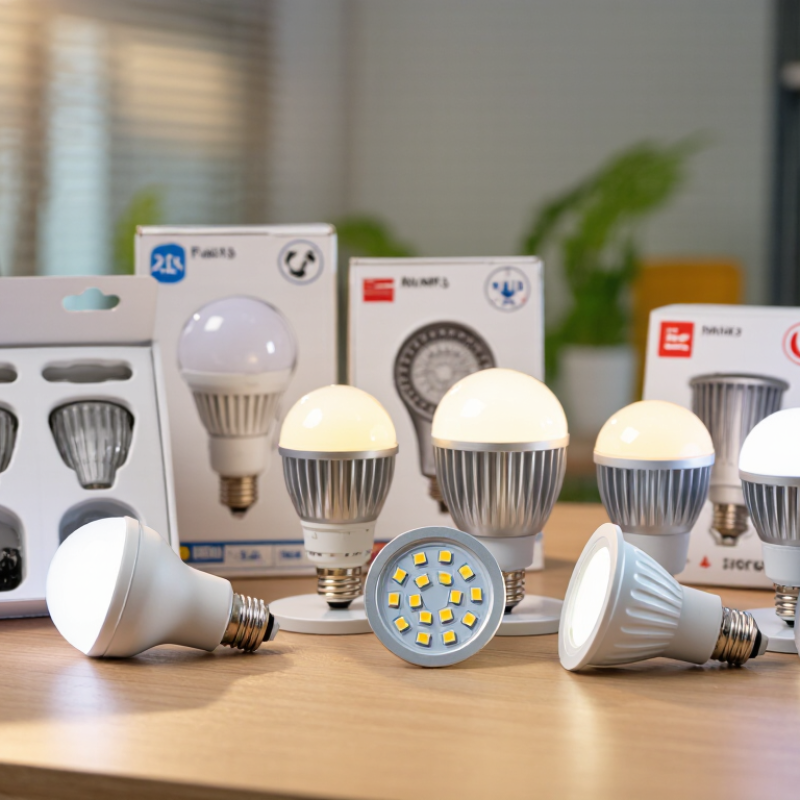
What Are the Best LED Bulbs for Global Buyers?

LED Bulb Types and Their Main Uses

What Are the Best LED Bulbs for Global Buyers?

LED Bulb Types and Their Main Uses

A-shaped LED bulbs are practical for bedrooms, living rooms, and ordinary table lamps. Their familiar shape spreads light evenly across a room. Choose lumens, not watts, when comparing brightness. Around 800 lumens often replaces a traditional 60-watt bulb. Warm white light suits bedrooms and restaurants. Neutral white works better in kitchens and study areas. Cool white can help workshops, although it may feel harsh at night.

Candle and globe bulbs suit decorative fixtures, wall lights, and pendant lamps. Their visible shapes can improve the fixture’s appearance. Reflector bulbs direct light toward counters, artwork, or display shelves. LED tubes are useful in offices, garages, and storage rooms. Corn bulbs can serve larger spaces, but they may look awkward in open fixtures. I once saw a decorative bulb used in a narrow hallway, and the light was attractive but too weak. Appearance is not performance.

Global buyers should check voltage, frequency, socket size, and dimmer compatibility before purchasing. A bulb designed for one electrical system may not operate safely in another. Look for clear lumen, color temperature, beam angle, and color rendering information. A CRI of 80 suits general lighting, while higher CRI helps clothing stores, kitchens, and galleries. Check heat management too. Enclosed fixtures can shorten LED life. Energy labels and test reports add useful confidence, but packaging claims still deserve careful review. Some choices remain uncertain. Real rooms, wall colors, and user habits can change the result.

Key Performance Factors for Comparing LED Bulbs

Global buyers should compare LED bulbs by measured performance, not appearance or promises. Lumens show brightness, while watts show energy use. A 10-watt bulb can produce different brightness levels across product lines. Efficacy, measured in lumens per watt, reveals efficiency more clearly. Check the declared input voltage before ordering. Some bulbs support broad voltage ranges, while others suit only one electrical system.

Color quality changes how rooms feel and function. A color temperature near 2700K creates warm light for bedrooms. Around 4000K looks clearer in kitchens and work areas. The color rendering index, or CRI, matters when accurate colors are important. A CRI above 80 is practical for general use. Higher values can improve clothing, food, and artwork appearance.

Beam angle also deserves attention. A narrow beam can highlight a table, while a wide beam spreads light across a hallway.

Flicker is easy to overlook. It may cause discomfort for sensitive users, especially during reading or filming. Look for transparent flicker information and test the bulb when possible. Rated life is useful, but heat, voltage changes, and frequent switching can reduce it.

I have seen “long-life” claims perform differently in enclosed fixtures. That deserves caution.

Confirm dimmer compatibility, operating temperature, socket size, and safety certifications recognized in the destination market. Product sheets are helpful, but independent test data is stronger. Sometimes the cheapest comparison is not the most reliable one.

Choosing the Right LED Bulb for Different Countries

What Are the Best LED Bulbs for Global Buyers?

Choosing the right LED bulb starts with the country, not the package. Electrical voltage varies widely. Many markets use 220–240 volts, while others commonly use 100–127 volts. Check the fixture rating before ordering.

A wrong voltage can cause flickering, overheating, or early failure.

Socket design matters just as much

E27, B22, GU10, and E14 bases are common, but they are not interchangeable. IEC 60061 provides international lamp-cap dimensions, yet local product availability still differs.

The U.S. Department of Energy’s Solid-State Lighting R&D Opportunities report notes that laboratory LED efficacy has exceeded 200 lumens per watt. Household bulbs usually deliver less. Real rooms, heat, and driver quality reduce performance.

Brightness should be compared in lumens, not watts. A 10-watt bulb may replace an older 60-watt incandescent lamp, but results vary by design.

The UNEP United for Efficiency initiative reports that lighting uses about 15% of global electricity, so efficiency has practical value.

Choose 2700–3000K for bedrooms and 4000–6500K for work areas.

Local safety marks and recycling rules also deserve attention.

I have seen buyers focus on price and ignore heat dissipation. That mistake is easy to repeat. A bulb can fit perfectly and still feel wrong in daily use.

Safety, Certification, and Compatibility Requirements

What Are the Best LED Bulbs for Global Buyers?

Safety, Certification, and Compatibility Requirements

A reliable LED bulb should match the buyer’s local electrical system. Check voltage, frequency, and socket type before comparing brightness or price. A bulb designed for 120 volts may fail on a 230-volt circuit. Fit is not universal. Measure the base and fixture carefully, especially for recessed lamps and narrow decorative fittings.

Certification is equally important. Look for safety marks accepted in the target market, then verify the certificate through an official database or supplier document. The paperwork should identify the exact model, not only the product family. Check test coverage for electrical shock protection, fire resistance, electromagnetic compatibility, and restricted substances. A printed logo alone proves very little. Keep records.

Real-world compatibility often depends on the fixture. Some LED bulbs flicker with older dimmers, timers, motion sensors, or smart switches. Others overheat inside sealed housings because their heat cannot escape. During sample checks, I examine the bulb after several hours in its intended fixture. I also compare measured wattage with the specification sheet. Small differences can reveal poor control or misleading claims.

Color temperature and light distribution deserve practical testing. A warm bulb may suit bedrooms, while a cooler output can improve warehouse visibility. However, color appearance changes across walls, lenses, and camera systems. One overlooked issue is start-up behavior in cold environments. A bulb can meet laboratory requirements yet perform poorly in an unheated storage area. That gap deserves attention before large-scale purchasing.

What Are the Best LED Bulbs for Global Buyers? - Safety, Certification, and Compatibility Requirements

Target Market Typical Mains Voltage Frequency Common Lamp Bases Safety and Certification Requirements EMC and Environmental Compliance Compatibility Checks Recommended Product Configuration
United States and Canada United States: 120 V
Canada: 120 V
60 Hz E26, E12, GU10, BR and PAR formats The bulb should comply with applicable electrical safety requirements for the destination country. Third-party safety certification by an organization accepted in the relevant market is commonly requested by retailers, utilities, authorities, and commercial projects. Electromagnetic compatibility and radio-frequency interference limits apply. Material restrictions, recycling obligations, and energy-efficiency rules may vary by federal, provincial, or state jurisdiction. Confirm 120 V operation, socket dimensions, dimmer compatibility, enclosed-fixture suitability, and ambient-temperature limits. 120 V, 60 Hz; dimmable version where required
European Union and EEA 230 V nominal
Typical operating range: approximately 220–240 V
50 Hz E27, E14, GU10, G9 and GU5.3 Products normally require conformity with the applicable Low Voltage, EMC, and product-safety legislation. CE marking is supported by a technical file and an EU Declaration of Conformity; the exact route depends on the product and applicable legislation. RoHS substance restrictions and WEEE obligations commonly apply. Applicable lamps may also be subject to EU ecodesign and energy-labelling rules. Check the energy label category, photometric performance, flicker, power factor, dimmer operation, and whether the lamp is suitable for enclosed luminaires. 220–240 V, 50 Hz; CE-compliant product documentation
United Kingdom 230 V nominal
Typical operating range: approximately 220–240 V
50 Hz B22d, E27, E14, GU10 and G9 The product must meet applicable Great Britain or Northern Ireland product-safety rules. The accepted conformity-marking route can depend on the destination within the UK and the applicable legislation; current government guidance should be checked before shipment. EMC, hazardous-substance, waste, and energy-efficiency requirements may apply. Energy information should be supplied in the format required for the intended market. B22d bayonet lamps are widely used. Verify lamp length, cap dimensions, dimmer compatibility, and enclosed-fitting restrictions. 220–240 V, 50 Hz; B22d or E27 options
Australia and New Zealand Australia: 230 V nominal
New Zealand: 230 V nominal
50 Hz B22d, E27, GU10 and E14 Electrical equipment must satisfy applicable national electrical-safety requirements. Regulatory registration, conformity evidence, and responsible-supplier obligations may apply depending on the product category and supply channel. EMC requirements apply, and energy-efficiency or product-stewardship obligations may vary by jurisdiction. Confirm B22d or E27 fit, 230 V operation, dimming performance, heat management, and suitability for enclosed fittings. 220–240 V, 50 Hz; B22d commonly preferred
Japan 100 V 50 Hz or 60 Hz, depending on region E26, E17, E11 and G-type bases Confirm compliance with Japan’s electrical-appliance safety framework where applicable. The required marking and conformity route depend on the product classification and Japanese distribution channel. EMC, energy-efficiency, recycling, and chemical-substance requirements may apply. A 100 V-rated lamp is required. Check regional frequency compatibility, socket size, physical clearance, and dimmer behavior. 100 V; 50/60 Hz compatible where possible
China 220 V 50 Hz E27, E14, GU10 and B22d Applicable compulsory or voluntary conformity requirements depend on the lamp type and sales channel. Documentation should identify the applicable Chinese standards, test reports, and required market-access marking. EMC, energy-efficiency, hazardous-substance, and recycling requirements may apply. Verify 220 V operation, cap dimensions, heat dissipation, dimmer compatibility, and local energy-label information. 220 V, 50 Hz; E27 is widely used
India 230 V nominal 50 Hz B22d, E27, E14 and GU10 Applicable Indian electrical-safety and product-quality requirements should be checked for the specific lamp category. Certification, registration, marking, and testing obligations may differ by product type and current regulatory notifications. EMC, energy-efficiency, environmental, and e-waste obligations may apply. B22d is common in residential applications. Confirm voltage tolerance, power quality tolerance, heat management, and surge performance. 220–240 V, 50 Hz; B22d option recommended
Brazil 127 V or 220 V, depending on location 60 Hz E27, E14, GU10 and B22d Lamps may be subject to Brazilian conformity-assessment and registration requirements. The required certification route depends on the product category and current national regulations. EMC and energy-efficiency requirements may apply, together with applicable environmental and waste rules. Confirm the local supply voltage before selection. A 127 V lamp must not be connected to a 220 V circuit. Separate 127 V and 220 V versions; 60 Hz
Multi-Region Export 100–240 V only when explicitly rated for universal input 50/60 Hz when explicitly specified E27 or E26, plus region-specific adapters or bases where permitted Certification is not automatically transferable between markets. A conformity mark or test report accepted in one jurisdiction may not satisfy another jurisdiction’s legal or retailer requirements. Prepare separate technical documentation, declarations, labels, packaging, and recycling information for each destination. Check base compatibility, lamp shape, maximum wattage, dimmer type, enclosed-fixture rating, ingress protection, and control-system compatibility. 100–240 V, 50/60 Hz; market-specific documentation

How to Select the Best LED Bulb for Your Market

Selecting the best LED bulb for a market starts with local conditions, not attractive packaging. Check the region’s voltage, frequency, socket standard, and indoor temperature before comparing prices. A bulb designed for 220–240 volts may fail quickly on an unstable supply. That detail matters. Ask distributors which bases sell most, such as screw or bayonet types. Then match brightness to room use. A small bedroom may need 800 lumens, while a workshop needs much more. Do not confuse wattage with light output.

Color temperature also changes buying decisions. Warm white suits bedrooms and restaurants, while neutral or cool white fits offices and retail spaces. For fresh food, clothing, or artwork, a high color rendering index can prevent disappointing colors. Beam angle deserves a sample test. A narrow beam may highlight shelves but create harsh shadows across a room. Review claimed lifetime, lumen maintenance, power factor, and heat management. These figures should come from test reports, not a sales sheet alone. Independent laboratory verification adds useful confidence. Still, paperwork is not performance.

Import requirements vary, so confirm required safety marks, recycling rules, and documentation with local authorities. Use samples in real sockets for several weeks. Check flicker with a phone camera, though that method is imperfect. Measure light after warm-up, not immediately after switching on. Packaging should show voltage, lumens, color temperature, base, and warranty terms clearly. A two-year warranty sounds reassuring, but only if replacement procedures are practical. Test bulbs in humid stores and dusty workshops. One mistake is assuming the cheapest unit creates the best margin. Sometimes it creates returns, complaints, and wasted labor. Leave room to revise your choice.

Article Source: