Choosing the right China Top 10 Centrifugal Vent Fan Manufacturers requires more than comparing catalog prices. A fan may look powerful on paper, yet struggle when connected to a long duct, a dirty filter, or a tight discharge elbow. Real performance depends on airflow, static pressure, motor efficiency, vibration control, noise, materials, and after-sales support. Small details matter. A loose bearing can become a costly failure.
Professor Hazim B. Awbi, a recognized ventilation researcher and author, defines ventilation as “the process of supplying air to and removing air from a space.” His statement keeps the evaluation practical. A Centrifugal Vent Fan is not merely a rotating wheel inside a metal casing. It is part of a complete air-moving system. That system must work safely in factories, commercial kitchens, workshops, warehouses, and public buildings.
This guide examines ten notable Chinese manufacturers through a balanced industry lens. It considers production experience, engineering capability, product range, testing practices, certifications, customization, export history, and customer feedback. Some companies appear impressive online but offer limited technical documentation. Others have quieter products but weaker delivery communication. That difference deserves attention.
The list should not be treated as an absolute ranking. Manufacturing quality can vary between models, batches, and suppliers. Buyers should request performance curves, motor details, noise data, inspection records, and installation guidance before placing an order. A useful comparison begins with evidence, not attractive photographs. Reliability is earned in operation, especially when the fan runs continuously under demanding conditions.
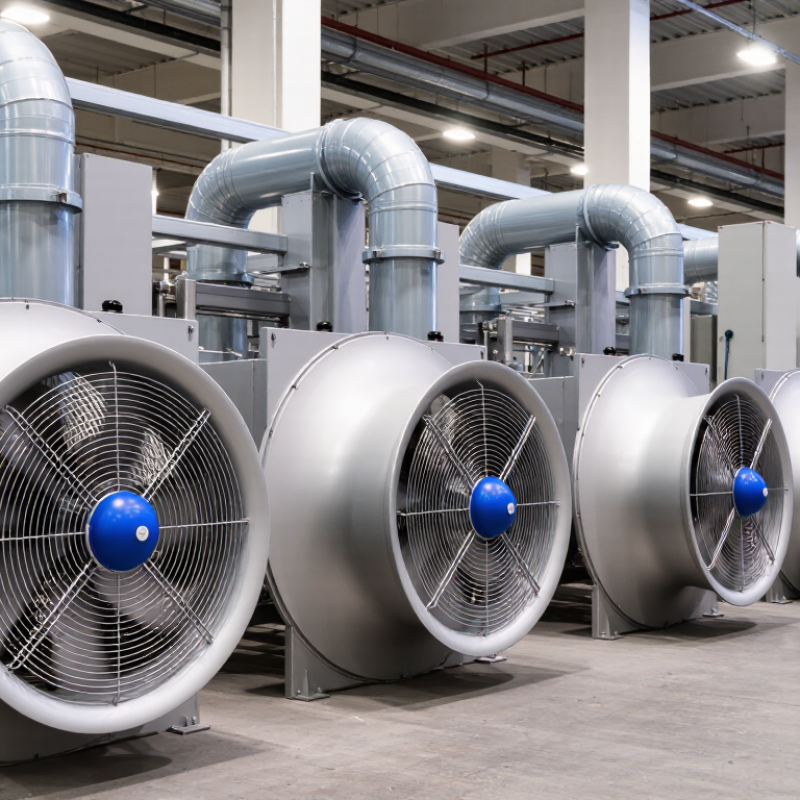
Centrifugal vent fans move air by changing its direction and increasing pressure. Unlike axial fans, they draw air through the center and discharge it outward through the housing. This design supports longer ducts, filters, and moderate resistance. It is widely used in workshops, kitchens, warehouses, and ventilation systems.
The main structure includes an impeller, motor, inlet, outlet, casing, shaft, and protective frame. Curved blades capture air near the hub. As the impeller spins, centrifugal force pushes air toward the casing. The scroll-shaped housing collects and guides it into the discharge outlet. In practical testing, airflow depends on speed, blade shape, duct length, and system resistance. A fan may appear powerful, yet perform poorly when the duct is narrow or sharply bent. That point is often underestimated.
Tips: Check the fan curve before selecting a model. Match airflow and static pressure, not airflow alone. Inspect bearings, belt tension, vibration, and dust buildup regularly. Keep the inlet clear. Small errors matter. Noise can also increase when the fan operates far from its rated point. Measurements from a real installation are more reliable than catalogue figures, although field readings may still contain errors. Good manufacturers explain these limits and provide traceable performance data.
| No. | Fan Configuration | Definition and Main Structure | Blade / Impeller Design | Typical Airflow (m³/s) | Typical Static Pressure (Pa) | Approx. Total Efficiency | Operating Principle and Typical Use |
|---|---|---|---|---|---|---|---|
| 1 | Forward-Curved Fan | Centrifugal housing, motor, shaft, inlet cone, and a relatively small impeller with many narrow blades. | Blades curve in the direction of rotation; commonly used with a scroll casing. | 0.1–2.5 | 50–800 | 55–75% | Produces high airflow at relatively low pressure and compact size; widely applied in air-handling units, fan-coil units, and light-duty ventilation. |
| 2 | Backward-Curved Fan | A scroll or free-discharge centrifugal assembly with a rigid impeller and motor-driven shaft. | Blades lean opposite to the direction of rotation, reducing aerodynamic slip. | 0.5–20 | 300–2,500 | 70–85% | Provides stable pressure and comparatively efficient operation; suitable for commercial HVAC systems and process exhaust. |
| 3 | Backward-Inclined Fan | Centrifugal wheel mounted inside a scroll or plenum housing, normally with a direct-drive or belt-drive motor. | Flat or curved blades slope backward without the enclosed airfoil profile of an airfoil wheel. | 0.2–15 | 250–2,000 | 65–82% | Offers non-overloading power characteristics and good efficiency for general ventilation, filtration, and air distribution. |
| 4 | Airfoil Fan | High-efficiency centrifugal fan comprising an aerodynamic wheel, inlet cone, housing or plenum, shaft, bearings, and drive. | Hollow or streamlined airfoil blades minimize turbulence and friction losses. | 1–30 | 500–3,000 | 80–90% | Converts motor power into airflow efficiently and quietly; commonly selected for large HVAC plants and energy-conscious systems. |
| 5 | Radial-Blade Fan | Heavy-duty centrifugal assembly with a robust wheel, scroll housing, shaft, bearings, and protective frame. | Straight blades extend radially from the hub and resist abrasion better than streamlined blades. | 0.1–10 | 500–5,000 | 55–75% | Handles dusty, particulate-laden, or moderately abrasive air in workshops, material-handling systems, and industrial exhaust. |
| 6 | Radial-Tip Fan | Centrifugal wheel and scroll casing designed to combine moderate efficiency with contamination tolerance. | Blade tips are radial while the blade channels are shaped to support higher pressure development. | 0.2–15 | 300–3,000 | 60–78% | Suitable for systems requiring moderate-to-high pressure, including dust collection, drying, and industrial process ventilation. |
| 7 | Plug Fan | Motor and centrifugal impeller installed without a conventional scroll casing, usually inside a pressurized plenum. | Usually backward-curved or airfoil blades with a controlled inlet cone. | 0.5–25 | 300–1,800 | 70–85% | Discharges air radially into the surrounding plenum and allows flexible duct connections; common in modular air-handling equipment. |
| 8 | Inline Centrifugal Fan | Compact cylindrical housing containing a centrifugal wheel, motor, inlet, outlet, and mounting brackets. | Compact backward-curved or forward-curved impeller aligned with the duct axis. | 0.1–5 | 100–1,000 | 55–75% | Moves air through inline ductwork where installation space is limited; used for bathrooms, kitchens, offices, and small commercial systems. |
| 9 | High-Pressure Centrifugal Fan | Reinforced centrifugal housing, narrow wheel, high-speed shaft, bearings, and motor or belt-drive transmission. | Typically radial or backward-curved blades designed for pressure generation. | 0.05–5 | 2,000–15,000 | 50–75% | Maintains airflow against high system resistance; applied to combustion air, pneumatic conveying, spray booths, and specialized process equipment. |
| 10 | Dust-Handling Centrifugal Fan | Industrial fan with reinforced casing, wear-resistant wheel, inspection access, shaft, bearings, and protective guards. | Open radial or backward-inclined blades reduce clogging and tolerate suspended particles. | 0.1–12 | 500–4,000 | 50–75% | Designed for contaminated or particle-bearing air in woodworking, cement, metalworking, filtration, and general dust-extraction systems. |
| Operating principle: The rotating impeller accelerates air radially outward through centrifugal force. The casing or plenum converts part of the air velocity into static pressure before the air enters the duct system. Actual selection should be based on the required airflow, total pressure, air temperature, density, noise limit, contamination level, motor power, and duty cycle. | |||||||