Choosing the right Sewer Inspection Cameras starts with understanding the job, not comparing prices alone. In the United States, the EPA estimates 23,000 to 75,000 sanitary sewer overflows occur annually. This figure appears in the EPA report, Impacts and Control of CSOs and SSOs. Many failures begin with roots, grease, cracked joints, or collapsed sections hidden from the surface.
The scale of the problem is substantial. The EPA’s 2022 Clean Watersheds Needs Survey identified approximately $630.1 billion in wastewater infrastructure needs over the next twenty years. The ASCE 2021 Infrastructure Report Card also rated U.S. wastewater infrastructure D+. These findings make accurate inspection more than a convenience. It is a practical maintenance decision. A suitable camera should match the pipe diameter, access point, distance, and expected obstruction. For example, a narrow household line may require a flexible push camera, while a large municipal pipe may need a crawler system with stronger lighting and pan-and-tilt control.
Specifications can mislead. A high-resolution screen does not guarantee useful findings in cloudy water. Look for a reliable footage counter, recording function, strong LED lighting, waterproof construction, and a locating sonde. Self-leveling improves image orientation around bends. However, no camera removes the need for trained interpretation. PACP-based reporting, supported by NASSCO practices, can help standardize observations. Still, judgment matters. A small root intrusion today may become a blockage tomorrow. The best choice balances image quality, maneuverability, service support, and total operating cost. That balance deserves careful reflection.
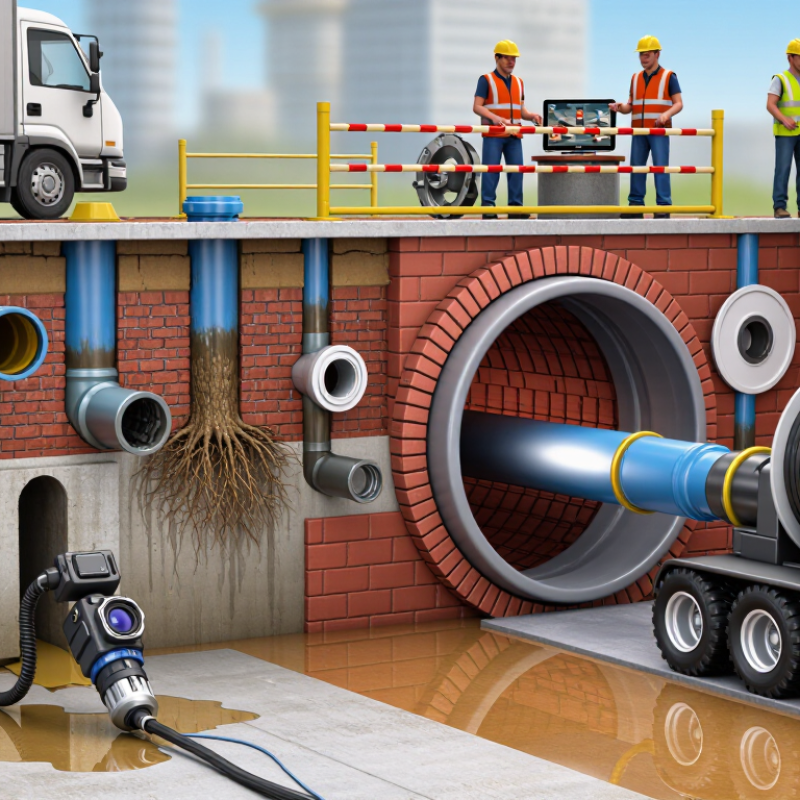
Choosing the best sewer inspection camera starts with understanding camera types and their practical uses. A compact push camera suits short residential lines and narrow pipes. Its flexible cable follows gentle bends, while built-in lighting reveals roots, cracks, and standing water. For longer runs, a reel camera offers greater cable length and stronger control. It can reach deeper sections without frequent repositioning.
A self-leveling camera keeps the image upright as the cable rotates. This helps technicians judge pipe joints and damage more accurately. Pan-and-tilt cameras provide a wider view, making them useful for locating offsets or complex connections. Crawler cameras work better in large commercial pipes because motorized wheels carry the camera steadily. Pipe diameter matters. A camera designed for a small drain may fail inside a wide, rough line. Waterproof housing, a strong locator, and clear recording also improve inspection reliability.
Tips: Match the camera head to the pipe diameter. Check cable length before entering the line. Clean the lens after muddy inspections. Record distance markers and notable defects. Even experienced operators can misread shadows as cracks. I sometimes recheck suspicious areas from two angles, because one view is rarely perfect. Don’t ignore image quality; a bright screen cannot fix a poorly positioned camera.
| Camera Type | Typical Pipe Diameter | Typical Reach or Cable Length | Movement and Viewing Features | Best Uses | Main Advantages | Main Limitations |
|---|---|---|---|---|---|---|
| Push Camera | Approximately 50–150 mm | Commonly 30–60 m, depending on the system | A flexible camera head is pushed through the pipe by a semi-rigid rod; most models provide forward viewing and LED lighting. | Residential drains, small commercial lines, branch pipes, and short inspection runs. | Portable, relatively simple to operate, and suitable for narrow pipes and quick diagnosis. | Limited ability to pass sharp bends, heavy deposits, or long sections; it cannot actively drive itself forward. |
| Self-Propelled Crawler Camera | Approximately 150–1200 mm or more, depending on wheel size and configuration | Often 100–300 m of tethered cable | Motorized wheels or tracks move the camera through the pipe; the camera usually provides pan, tilt, rotation, and adjustable lighting. | Municipal sewers, stormwater lines, industrial pipelines, and long or large-diameter inspections. | Stable movement, high-quality video, accurate defect documentation, and better performance in large pipes. | Higher purchase and operating costs; transportation and setup may require more equipment and trained personnel. |
| Pan-and-Tilt Zoom Camera | Generally 150–2000 mm, depending on the camera head and mounting system | Usually installed on a crawler with a long tether | The lens can rotate and tilt to inspect the full pipe circumference; optical or digital zoom helps examine defects in detail. | Large sewer lines, manholes, joints, connections, cracks, deformation, and internal structural assessment. | Provides a broad inspection view and detailed close-up images without repositioning the crawler frequently. | More complex and expensive than a fixed-view camera; image quality depends on lighting, lens cleanliness, and pipe conditions. |
| Lateral Launch Camera | Main line commonly about 150–1200 mm; lateral lines often about 75–200 mm | Main-line tether plus a deployable lateral cable, often extending tens of metres | A secondary camera or launching mechanism enters connected branch lines through a service connection or opening. | Inspecting property laterals, service connections, branch drains, and the junction between a main line and a lateral. | Inspects multiple connected pipes from one access point and helps identify the location of defects in lateral lines. | Requires suitable access and adequate pipe geometry; deployment is more complicated than standard push inspection. |
| Sonde-Equipped Inspection Camera | Commonly used in pipes from approximately 50–200 mm | Typically matches the push cable or crawler tether length | Includes a small radio transmitter, or sonde, that can be detected above ground with a compatible locator. | Finding buried pipe routes, locating blockage positions, identifying service connections, and marking excavation points. | Adds above-ground location data to the video inspection and helps reduce unnecessary excavation. | The locating range can be affected by pipe depth, soil conditions, metal structures, and other sources of signal interference. |
| Manhole and Vertical Inspection Camera | Manholes, shafts, tanks, and other vertical or large-access structures | Commonly mounted on a telescopic pole or lowered on a cable; reach varies by configuration | Wide-angle viewing, powerful lighting, and adjustable camera orientation for vertical or open-structure inspections. | Manhole walls, benches, channels, wet wells, tanks, culverts, and other areas that are difficult or unsafe to enter. | Improves operator safety and provides visual access without requiring personnel to enter a confined space. | Not designed for navigating long, enclosed horizontal pipelines unless combined with a suitable deployment system. |
| Selection note: Choose the camera according to pipe diameter, access points, inspection distance, pipe condition, required image detail, and whether underground defect location or lateral-line access is needed. The stated dimensions are typical working ranges and can vary by equipment configuration and site conditions. | ||||||

How to Choose the Best Sewer Inspection Cameras?
Image quality should reveal defects, not merely produce a sharp-looking screen. Look for stable focus, balanced lighting, and clear color separation. A reliable camera should show hairline cracks, root intrusion, standing water, and displaced joints. Excessive glare can hide damage inside wet pipes. In field inspections, I have found that moderate resolution with strong lighting often beats higher resolution with poor exposure. That assumption is worth testing on your own site.
Tips: Compare sample footage from dark, wet pipes. Check whether details remain visible when the camera head moves. A bright screen alone proves little.
Camera head size must match the pipe and its bends. Smaller heads travel more easily through narrow lines and tight elbows. Larger heads may provide stronger lighting and better image stability. However, forcing an oversized head can damage the equipment or stop the inspection early. Measure the pipe diameter before choosing. Viewing range also matters. Consider cable length, signal stability, and how far the camera can see clearly. A long cable is useless if the image becomes noisy halfway through the line. Record distance markings during the inspection, but do not trust them blindly. Cable flex and slipping can create small measurement errors.
Choosing a sewer inspection camera starts with the pipeline, not the screen. Cable length determines reach, but longer is not always better. In a small residential drain, a 30-meter cable can create unnecessary loops and friction. A shorter 15-meter cable may move more predictably around traps and tight bends. For deep outdoor lines, extra length matters. Yet unused cable needs careful handling, or it may kink beside the reel. I once assumed maximum reach meant better performance. That was not always true.
Flexibility should match the pipe’s shape and diameter. A soft push cable follows several bends, especially in narrow household drains. However, excessive softness can reduce pushing force in longer or partially blocked lines. A stiffer cable enters straight pipelines more effectively, but may struggle at sharp elbows. Check the camera head diameter, cable diameter, and minimum bend radius together. Compatibility also includes pipe material and access size. A camera that fits a 100-millimeter pipe may not enter a 50-millimeter branch. Measurement errors are easy, and they can ruin an otherwise capable inspection.
Tips: Measure cleanout depth before choosing cable length. Confirm the smallest pipe diameter, bend count, and expected obstruction. Ask for tested working ranges, not only advertised maximums. Keep the cable clean and loosely coiled after use. Record distance readings and viewing conditions. Even experienced users can misjudge distance when the pipe is wet, dark, or unusually curved.
Choosing a sewer inspection camera requires more than chasing image resolution. In field work, lighting often determines whether a crack is visible or lost in glare. Choose adjustable LEDs with even coverage, not a harsh central beam. The lens should reveal pipe walls, joints, roots, and standing water at close range. A high-resolution image can still mislead when the light is poorly controlled.
Recording features matter because inspection decisions depend on evidence. The camera should save clear video, still images, timestamps, distance markers, and inspection notes. Common file formats also simplify sharing with engineers and maintenance teams. NASSCO’s PACP guidance emphasizes consistent observations and documented visual evidence. That matters when comparing damage over several years. Store files securely. Label them carefully. Small mistakes happen.
Durability is equally important. The U.S. Environmental Protection Agency’s 2022 Clean Watersheds Needs Survey identified about 630.1 billion dollars in wastewater infrastructure needs. ASCE’s 2021 Infrastructure Report Card gave wastewater infrastructure a D+ grade and estimated 472.6 billion dollars in needs. These figures show why inspection equipment must survive repeated, demanding use. Look for a sealed camera head, flexible but strong cable, water resistance, and stable performance in cold, muddy conditions. Check battery endurance too. A camera that fails halfway through a long line wastes labor and weakens the record. I would not assume the most expensive system is automatically the most reliable. Test it in a dark, wet pipe before trusting it on a critical inspection.
How to Choose the Best Sewer Inspection Cameras?
Selecting the Right Camera for Your Inspection Requirements
The right sewer camera depends on pipe diameter, access, length, and expected defects. A compact push camera suits small residential lines and short runs. Larger pipes may require a crawler with adjustable lighting and stable wheels. Image quality matters, but it is not everything. A bright screen cannot correct a poorly centered lens.
The U.S. Environmental Protection Agency’s 2022 Clean Watersheds Needs Survey estimated $630.1 billion in wastewater infrastructure needs over 20 years. That scale makes dependable inspection records increasingly important. The ASCE 2021 Infrastructure Report Card rated U.S. wastewater infrastructure D+. These figures support careful equipment selection, not rushed purchasing.
Check the camera head diameter first. It should pass bends without scraping the lens. A self-leveling camera keeps cracks and joint offsets upright on screen. For deeper lines, choose a strong push cable, distance counter, and sonde locator. Water-resistant controls are practical in muddy chambers. They also reduce handling mistakes.
Ask whether the system records clear video, still images, timestamps, and location notes. A field technician may need to compare today’s blockage with last year’s footage. Storage failure is an avoidable weakness. I would test the camera on a damaged training pipe before using it underground. On paper, a wide viewing angle looks impressive. In practice, it can hide defects near the wall. That detail is easy to miss.
Selecting the right camera depends mainly on pipe diameter, inspection distance, and the required image detail.
These representative field-selection values show how camera head size and push-cable length typically increase with pipe size and inspection distance. Smaller heads are better for narrow residential drains, while larger pipes generally require longer cables, stronger illumination, and higher-centering camera systems.
| Cookie | Duration | Description |
|---|---|---|
| cookielawinfo-checkbox-analytics | 11 months | This cookie is set by GDPR Cookie Consent plugin. The cookie is used to store the user consent for the cookies in the category "Analytics". |
| cookielawinfo-checkbox-functional | 11 months | The cookie is set by GDPR cookie consent to record the user consent for the cookies in the category "Functional". |
| cookielawinfo-checkbox-necessary | 11 months | This cookie is set by GDPR Cookie Consent plugin. The cookies is used to store the user consent for the cookies in the category "Necessary". |
| cookielawinfo-checkbox-others | 11 months | This cookie is set by GDPR Cookie Consent plugin. The cookie is used to store the user consent for the cookies in the category "Other. |
| cookielawinfo-checkbox-performance | 11 months | This cookie is set by GDPR Cookie Consent plugin. The cookie is used to store the user consent for the cookies in the category "Performance". |
| viewed_cookie_policy | 11 months | The cookie is set by the GDPR Cookie Consent plugin and is used to store whether or not user has consented to the use of cookies. It does not store any personal data. |