Choosing China’s top Single Vsd Compressor manufacturers requires more than comparing motor power or catalog prices. A compressor may look excellent on paper, yet perform poorly when factory demand changes every few minutes. In a packaging plant, for example, air consumption can fall sharply after a filling line stops. A reliable variable-speed compressor should respond smoothly, avoid excessive unloaded running, and maintain stable pressure near 7–8 bar.
Hank Van Ormer, a recognized compressed-air systems expert, has stated, “The compressor is only one part of the compressed air system.” This practical warning shapes our evaluation. Manufacturers should be examined through motor efficiency, inverter control, air-end design, cooling performance, noise levels, controller accuracy, and after-sales service. Oil-injected screw models remain common, but their filters, separators, and maintenance access deserve close inspection. Small details matter. A difficult-to-reach separator can increase service time and operating cost.
This guide explores leading Chinese manufacturers from a buyer’s viewpoint, not merely a marketing viewpoint. It considers factory experience, export support, certifications, spare-parts availability, warranty responsiveness, and lifecycle performance. “Top” is not a permanent label. A large brand may offer strong engineering but weak local support in one region. A smaller supplier may provide faster customization, yet lack long-term field data. That difference should not be ignored.
Our comparison also has limits. Published efficiency figures may use different test conditions, making direct comparisons imperfect. Buyers should request measured flow, specific power, pressure range, and performance records. The best choice is the manufacturer that matches the real demand profile, not the most impressive brochure.
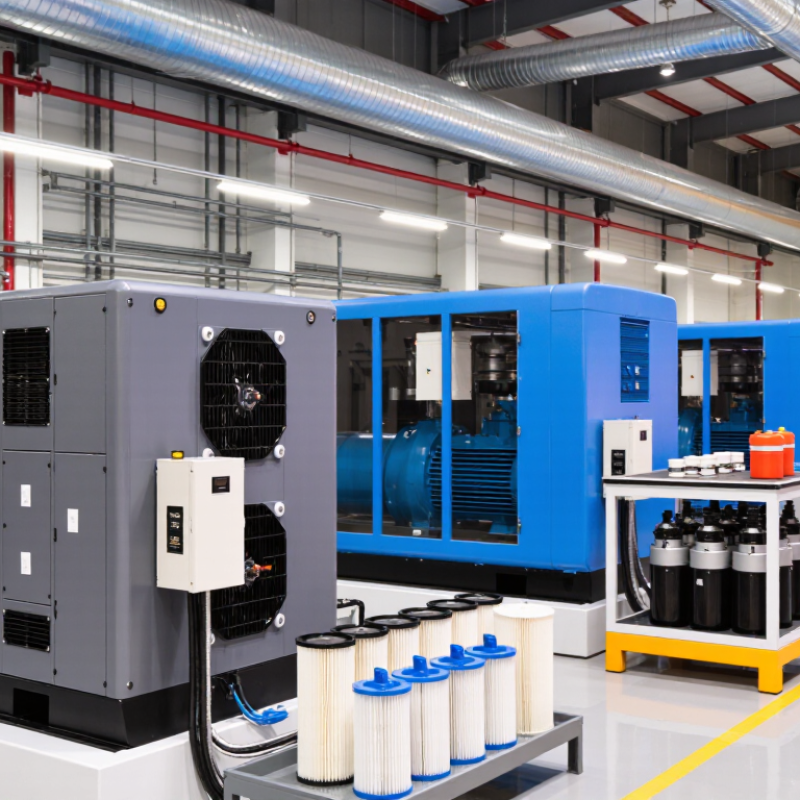
A single VSD compressor is an air compressor controlled by one variable speed drive. The drive changes motor speed as air demand rises or falls. “Single” usually means one compressor unit, not a single-phase electrical supply.
A fixed-speed compressor often runs at full speed, then unloads or stops. A VSD model slows down during lighter demand and speeds up when production needs more air. This can reduce wasted energy, especially in facilities with changing workloads. For example, a workshop may need 8 bar during tool use but far less air between production cycles. The controller responds within seconds. Small details matter.
In practical purchasing, I would check the pressure sensor, motor efficiency, cooling design, and inverter protection. Ask for factory test records, noise data, maintenance intervals, and local service capability. Chinese manufacturers may offer different configurations, so comparing only motor power can be misleading. A 37 kW compressor is not automatically more efficient than a well-matched 30 kW model. The actual result depends on leakage, operating hours, pressure settings, and installation quality.
A VSD does not remove every problem. Its drive may generate heat and require clean electrical conditions. Its savings can also disappoint when demand stays nearly constant. I once treated variable speed as a complete efficiency solution; that assumption was too simple. Measure the air profile first. Then match the compressor, receiver tank, dryer, and controls to real factory conditions.

A single VSD compressor uses one variable speed drive to adjust motor speed according to compressed-air demand. The reference profile below is based on a 50 Hz rated motor and an ideal proportional relationship between drive frequency and normalized airflow. Actual performance varies with compressor type, pressure, temperature, and control settings.
As the VSD command increases, motor frequency and normalized airflow increase proportionally within the modeled operating range. This enables the compressor to better match changing demand than a fixed-speed operating mode.
A single VSD compressor changes motor speed to match a factory’s air demand. Its pressure sensor reads the discharge line continuously. An inverter then adjusts electrical frequency and motor rotation. When production slows, the motor decelerates instead of running fully loaded. This reduces wasted energy during partial-load periods.
In many Chinese factories, systems operate around 380 volts and 50 hertz, although site conditions vary. The controller balances pressure, temperature, and motor protection. The air end compresses air, while separators remove oil from the discharge stream. Proper cooling matters in humid workshops and dusty industrial areas. I have found that clean filters often influence efficiency more than expected. Small details matter.
Manufacturers in China normally test pressure stability, insulation, vibration, and control response before shipment. Reliable suppliers also check compatibility with local piping, voltage quality, and maintenance practices. A commissioning engineer should record pressure, power consumption, and operating hours under real production loads. Catalog efficiency can look impressive. Actual results may differ. Operators sometimes set pressure higher than necessary, creating avoidable energy use. Regular inspections of belts, filters, drains, and sensors help protect performance, but maintenance schedules should follow the machine’s design and working environment.
Selecting a Chinese single VSD compressor manufacturer requires more than comparing quoted prices. Examine factory experience, engineering depth, and documented project results. Ask how many similar units operate in dusty factories, cold warehouses, or high-humidity workshops. Real operating evidence matters.
Request motor and inverter specifications, control logic details, efficiency curves, and noise data at different load levels. A polished catalog proves little. Reliable manufacturers explain testing methods clearly and provide traceable inspection records. Check pressure stability, oil separation, cooling performance, and the protection system during frequent starts and stops. Independent certifications can support credibility, but certificates should match the exact model.
Factory visits reveal practical details. Look at assembly cleanliness, wiring quality, spare-parts storage, and final testing procedures. Speak with technical staff, not only sales representatives. Their answers should cover installation, commissioning, maintenance intervals, and fault diagnosis. Response speed matters too. A compressor is not reliable if support disappears after delivery.
Review warranty terms carefully. Clarify coverage for the inverter, motor, air end, sensors, and controller. Confirm service response times and the availability of replacement parts in your region. I would not choose the lowest bid without calculating electricity costs over several years. Still, energy projections are only estimates. Actual savings may fall when demand changes, filters clog, or operators use incorrect settings. That uncertainty deserves honest discussion.
China’s leading single VSD compressor manufacturers are gaining attention through efficient engineering and flexible production. Their systems typically serve workshops, factories, food processing sites, and automated assembly lines. A single variable speed drive adjusts motor output as air demand changes. This can reduce unloading time and unnecessary power consumption.
Experienced buyers should examine more than catalog efficiency figures. Check the compressor’s operating range, inverter cooling design, oil separation performance, and controller response. A reliable supplier should provide measured airflow data, pressure stability records, and service documentation. Factory visits can reveal important details. Look for clean assembly areas, calibrated testing equipment, traceable components, and technicians who explain failures clearly.
Chinese manufacturers differ in specialization. Some focus on compact 7.5–37 kW units for small workshops. Others build larger machines with remote monitoring, low-noise enclosures, and heat recovery options. Ask about motor insulation, bearing quality, filter replacement intervals, and local spare-part availability. These details affect ownership costs more than a low purchase price.
Certification matters, but it is not the whole story. Request current test reports and verify whether they match the offered configuration. A supplier may advertise impressive savings under ideal conditions. Real demand often changes by shift, season, and production schedule. That gap deserves careful measurement. Even strong manufacturers can improve their documentation, especially when translating technical data for overseas customers. Clear communication remains a practical sign of reliability.
Single VSD compressors suit facilities with changing air demand. They adjust motor speed instead of running fully loaded continuously. This can reduce wasted energy during production pauses or partial-load shifts. Common applications include food processing, workshops, electronics assembly, packaging, and general manufacturing. They also support pneumatic tools, filling lines, and automated handling equipment.
Selection should begin with the actual air profile, not the advertised motor size. Record pressure, flow, operating hours, and peak demand across several production cycles. A compressor sized only for the highest short-term peak may run inefficiently for most of the day. Check the required pressure at the point of use, including pipe losses and treatment equipment. Air quality is equally important. Oil-free or oil-injected designs may fit different process requirements. Confirm filtration, drying, ventilation, and maintenance access before purchase.
Control range deserves careful attention. Some VSD units become less efficient near their minimum speed. A receiver tank can reduce rapid cycling and stabilize pressure. Inverter compatibility, starting current, ambient temperature, and service support also affect reliability. Small details matter. I have seen selection errors caused by using old production data. That lesson needs repeating: demand changes after expansion. Recheck measurements before approving the specification. A technically impressive compressor can still perform poorly when installation conditions are ignored.
Technical comparison of common single variable-speed-drive compressor configurations, applications, and selection factors
| Evaluation Dimension | Typical Technical Information | Recommended Application | Selection Considerations | Verification Points |
|---|---|---|---|---|
| Compressor Type | Oil-injected rotary screw compressor with one variable-speed drive controlling motor speed. | Facilities with fluctuating compressed-air demand and extended operating hours. | Confirm whether oil-free air, reciprocating technology, or a fixed-speed unit is more suitable for the process. | Check the compressor technology, lubrication method, air-quality class, and operating profile. |
| Motor Power Range | Common commercial configurations are approximately 7.5–315 kW, although available ranges vary by product series. | Small workshops, general manufacturing, assembly plants, and medium-sized process systems. | Select power from measured demand, not only from the connected-load rating of existing equipment. | Review rated motor power, service factor, motor efficiency class, and permissible speed range. |
| Nominal Pressure | Typical working-pressure options include 7–8 bar, 10 bar, 13 bar, and 16 bar; exact values depend on the model. | Pneumatic tools, packaging, textile equipment, electronics assembly, and general plant air. | Choose the lowest pressure that satisfies the end-use requirement to avoid unnecessary energy consumption. | Compare rated pressure, maximum pressure, pressure drop, and the actual pressure required at the point of use. |
| Variable-Speed Range | The inverter adjusts motor speed within a manufacturer-defined operating envelope to match air demand. | Systems with frequent load changes, shift-based production, or demand variation during the day. | A wider usable turndown range can improve part-load performance, but very low demand may require a storage tank or multiple compressors. | Request the flow-versus-speed curve and confirm minimum stable capacity. |
| Air Delivery | Free-air delivery is normally specified in m³/min, m³/h, or CFM and changes with pressure and speed. | Applications requiring stable pneumatic performance across changing production loads. | Do not compare flow figures without checking test conditions, discharge pressure, inlet temperature, and measurement standard. | Compare certified or clearly defined FAD data at the intended operating pressure. |
| Energy Performance | Energy use depends on specific power, pressure setting, leakage, inlet conditions, control strategy, and operating hours. | Plants where the compressor operates for long periods below full load. | Evaluate total lifecycle cost rather than purchase price alone; avoid oversizing because it can reduce part-load efficiency. | Request specific-power data in kW/(m³/min) or kW/CFM at the required pressure. |
| Control and Communication | Common functions include pressure control, automatic start/stop, fault alarms, maintenance reminders, and remote monitoring. | Factories integrating compressed air into energy-management or building-management systems. | Confirm compatibility with the plant network and required protocols before purchase. | Check available interfaces such as Modbus RTU/TCP, Ethernet, digital I/O, and alarm contacts. |
| Cooling Method | Air-cooled and water-cooled designs are both used; air-cooled units are common for general industrial installations. | Air-cooled: standard factories; water-cooled: sites with suitable cooling-water infrastructure and high ambient loads. | Consider ambient temperature, ventilation, water quality, maintenance access, and installation space. | Verify allowable ambient temperature, cooling-water requirements, heat rejection, and ventilation capacity. |
| Air Quality | Oil-injected compressors require downstream separation and filtration; dryers may be needed to control moisture. | General industrial air, instrumentation air, food-contact processes, and spray applications with suitable treatment. | Define required ISO 8573-1 purity class, pressure dew point, residual oil, and particle limits. | Check separator performance, filtration stages, dryer type, condensate management, and validation procedures. |
| Noise and Installation | Noise levels vary by enclosure, speed, cooling fan, and operating condition; installation needs adequate airflow and service clearance. | Indoor production areas, utility rooms, and compact industrial compressor rooms. | Assess sound limits, floor loading, lifting access, ventilation, pipe sizing, and condensate drainage. | Request sound-pressure data, dimensional drawings, foundation requirements, and maintenance clearances. |
| Electrical Requirements | Most industrial units use three-phase power; voltage, frequency, starting current, and harmonic behavior depend on the drive system. | Commercial and industrial facilities with stable three-phase electrical service. | Confirm supply voltage, frequency, short-circuit capacity, protection, grounding, and power-quality limits. | Review electrical schematic, input-current data, EMC compliance, IP rating, and required protective devices. |
| Maintenance and Service | Routine service commonly includes oil, oil filter, air filter, separator element, cooler, belts or couplings, and drive-system inspections. | Operations requiring predictable uptime and manageable maintenance intervals. | Evaluate local technical support, spare-parts availability, service training, and planned-maintenance requirements. | Obtain the maintenance schedule, consumables list, warranty terms, and emergency-response arrangements. |
| System Sizing Strategy | Sizing should be based on measured flow demand, pressure profile, leakage, duty cycle, future expansion, and required redundancy. | Single-compressor installations with relatively predictable peak demand and acceptable backup arrangements. | For critical production, consider multiple compressors, standby capacity, an appropriately sized receiver, and automatic sequencing. | Use data logging or an air audit where possible; verify peak flow, minimum flow, pressure fluctuations, and leakage rate. |
Note: Technical ranges are representative industry values rather than specifications for a particular manufacturer. Final selection should be based on verified performance data, applicable safety requirements, site conditions, and the complete compressed-air system design.
| Cookie | Duration | Description |
|---|---|---|
| cookielawinfo-checkbox-analytics | 11 months | This cookie is set by GDPR Cookie Consent plugin. The cookie is used to store the user consent for the cookies in the category "Analytics". |
| cookielawinfo-checkbox-functional | 11 months | The cookie is set by GDPR cookie consent to record the user consent for the cookies in the category "Functional". |
| cookielawinfo-checkbox-necessary | 11 months | This cookie is set by GDPR Cookie Consent plugin. The cookies is used to store the user consent for the cookies in the category "Necessary". |
| cookielawinfo-checkbox-others | 11 months | This cookie is set by GDPR Cookie Consent plugin. The cookie is used to store the user consent for the cookies in the category "Other. |
| cookielawinfo-checkbox-performance | 11 months | This cookie is set by GDPR Cookie Consent plugin. The cookie is used to store the user consent for the cookies in the category "Performance". |
| viewed_cookie_policy | 11 months | The cookie is set by the GDPR Cookie Consent plugin and is used to store whether or not user has consented to the use of cookies. It does not store any personal data. |